Tuesday, September 14, 2021

Architect Anna Koosmann and Estudio Damgo Program Receives U.S. National Research Award.

Architect Anna Koosmann and Foundation University, received a U.S. national award from the Environmental Design Research Association (EDRA) in 2018 for the research on the Estudio Damgo design-build program. Koosmann used her Fulbright research grant to evaluate the first three Filipino bamboo projects: a rural classroom, a multipurpose hall, and a floating guardhouse. The post-occupancy research conducted on the buildings, as well as input from beneficiary interviews, steered future design-build projects, by guiding Filipino instructors and institutionalizing the design-build program for lasting success. Koosmann worked alongside the University's Research Director, Geraldine Quinones, Architecture department heads, and Estudio Damgo students for five months of field research, earning a national EDRA Core award. Koosmann presented the research findings and accepted the award at the 49th EDRA conference in Oklahoma City, U.S.  View the entire document, 

"Estudio Damgo: Evaluating the Impact of the First, Filipino Design-Build University Program", at https://www.edra.org/page/2018_core_recipients


Excerpt from EDRA core research document.


Excerpt from EDRA core research document.

Signing Agreements between Core Shelter Community and the City of Dumaguete at the official turn-over for the Multipurpose Hall 2015. Pictured Left to Right: Dean Sinco, Johna David, Anna Koosmann, William Ablong, Orlando E. Enquig, and Core Shelter residents.


Wednesday, May 18, 2016

Pagka-pinay "being Filipino" at Global M.A.D.E. Gallery 120


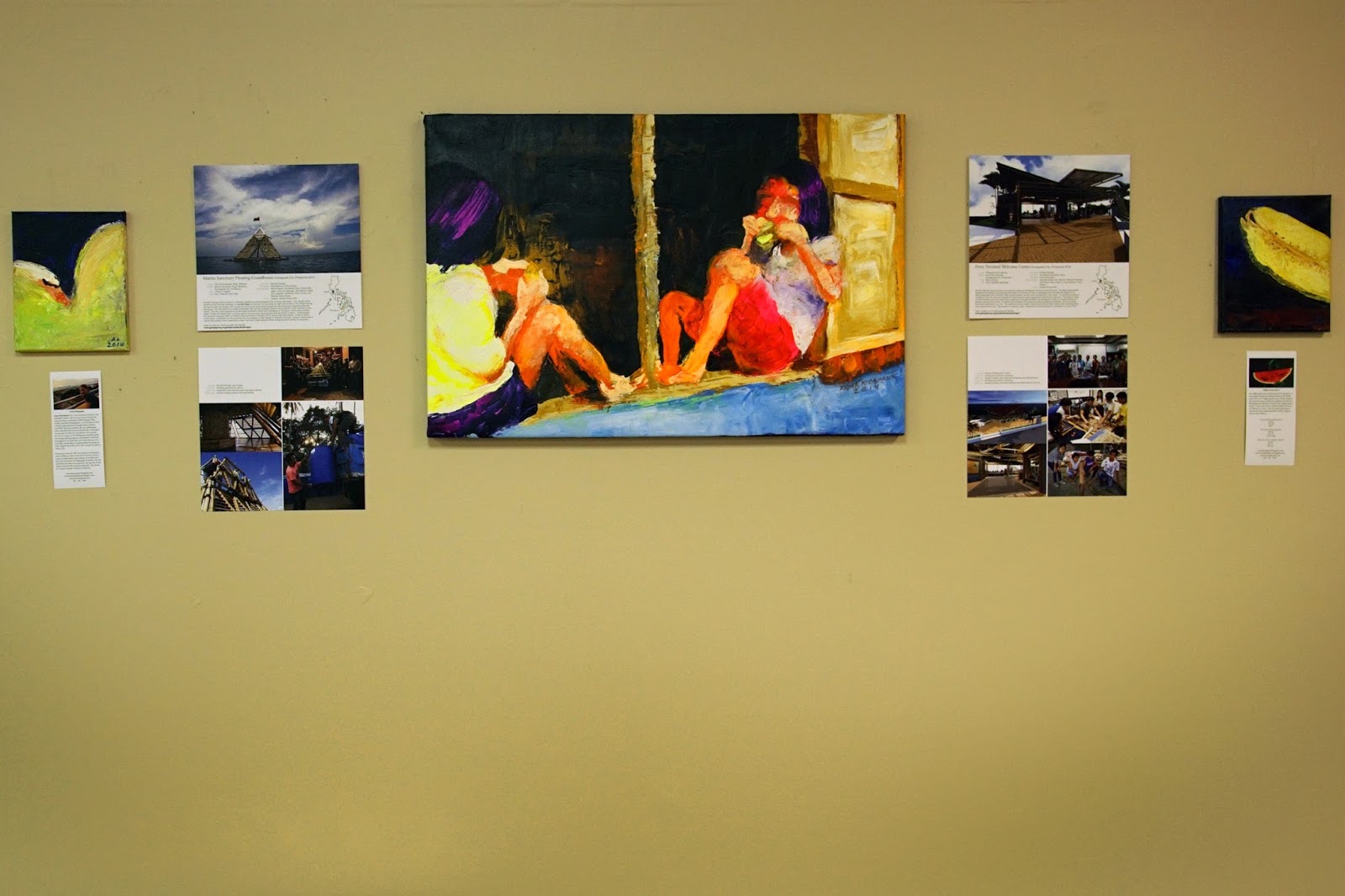
The Philippines works are up on the wall at Global M.A.D.E. Gallery 120 in my hometown community.  Printed photographs of the four, Estudio Damgo projects were among paintings I created while living in the Philippines for over 2 years.  It brings me great joy to share my experiences abroad with people from my childhood who came out to the art opening.  Read more at: A + w o r k s


Thursday, February 4, 2016

Sustaining Communities Through Design-Build Education


Receiving my Fulbright certificate at the Philippine-American Educational Foundation holiday party on December 17, 2015. - Photo by Hersley-Ven Casero

My five months as a Fulbright scholar and consulting architect for Foundation University's design-build program has flown by!  From August - December 2015 I teamed up with ma'am Geraldine Quinones the director of research and community extension to research the first three Estudio Damgo community projects: Dungga daycare, multipurpose hall, and the floating guardhouse.  I used this research to institutionalize the design-build program by creating an advisory committee made up of department heads, faculty, and Estudio Damgo alumni.  As a committee we created guidelines for the program and future projects.  You can read about my experiences in the feature article in Dumaguete City's Metropost, "Sustaining communities thru design-build education".

It's already February 2016 and just over two weeks after I returned to the Midwest to establish my career back home.  As my time was winding down with the Fulbright in the Philippines last month, we had a tragic loss of a Foundation University colleague and friend, Phil Prins.  His death hit the university hard.  Being a close friend, I was engrossed in grieving his death for several weeks with the Filipino community at the end of my stay.  Although my time in the Philippines on the Fulbright has been the shortest since I have been involved in Estudio Damgo, these past months I felt more deeply rooted because of these human experiences.  The mother of Phil Prins said it best regarding grief and funerals,

"Filipinos do it right, they communicate and come together to support the grieving process.  They spend time with the deceased body at all hours of the day, never leaving it alone. They play games, share stories, and they talk about it over many days.  American's have formal funeral gatherings that are limited to specific times, and we don't talk about it, instead we go off on our own to grieve alone." - Kay Prins

She reflected on the journey to the Philippines for her son's funeral, and feels she has gained a family abroad.  It was an unexpected blessing to cope with the Filipino community in her state of grief.  Phil's death opened me to a whole new understanding about life, death, and grief through the heart of another culture.  I am grateful to have been able to authentically participate and cope in a different way, even though it was a culture shock for me to spend so many hours connected with so many people, to share and play games, I eventually found the benefit of going through the pain and loss with everyone.  I was able to make peace over those few weeks and it was a natural process to let go and find some resolution in Phil's death.  And through Phil's death, I was able to connect with nearly everyone I know in Dumaguete City linked with Foundation University before returning to the States.  For me it was a reunion.

As I reflect on those experiences while building my practice in community and public interest design,  I've learned that being part of a community takes time.  Strong communities naturally stem from strong family roots and connections.  You must share in the joys of life by being present at births, weddings, and celebrations and grieve alongside one another during a time of loss.  Being integrated fully means you participate at a human scale with human emotions attached.  For me, it's a good indication of how deeply rooted I am in a community, is whether I've shared in human events like births, weddings, and funerals.  I've lived many places in the United States and prior to the Philippines I had not felt as fully integrated into American communities for the lack of family connections, as I had in the Philippines.  Over the past three years, I've felt welcomed and embraced by Dumaguete City and Foundation University - and most certainly *been "daggit" by the "city of gentle people".

* been "daggit" is a Visayan saying: when someone traveling from outside of Dumaguete City stays for a long time, usually longer than they had originally planned, and eventually make it their home. 

Saturday, November 14, 2015

CHROMATEXT Rebooted


Pictured with Filipino national artist, BenCab and Hersley-Ven Casero at CHROMATEXT Rebooted art opening. - Photo courtesy of Hersley Casero and Annabelle Lee Adriano
On Friday November 6, I attended the opening for "CHROMATEXT Rebooted" at the Cultural Center of the Philippines (CCP) in Manila with Hersley-Ven Casero.  Curated by Jean Marie Syjuco and Krip Yuson, "CHROMATEXT Rebooted" is a revival show from 2007, themed around visual representations tied to literature.  Joining 130 artists from the Philippines, the U.S., Canada, Australia, and Singapore, featured a mix of collaborations between visual artists and writers.  Highlights include: rubbing elbows with renowned national artists, like BenCab and guest of honor, Cirilo F. Bautista; the live dance and percussion performance by Agnes Arellano and Billy Bonnevie; and the jazzy, spoken word acknowledgements by Krip Yuson.  Hersley was one of the few artists to represent Dumaguete among Kitty Taniguchi, Annabelle Lee Adriano, and Elle Divine.    This evening marked a pivotal moment in Hersley's art career, not everyone gets the opportunity to show at the CCP, especially those lying outside the Manila arts network.  This was Hersley's first time, which bodes well for his career and for the province.  Hersley exhibited current works from his Stone series, which stood out for their minimal quality and meticulous detail.  The curator's daughter hand-picked Hersley's Stones and placed them next to her artwork because she liked them so much.  The art opening was a refreshing way to travel outside of Dumaguete for a memorable night of art appreciation.  It was an honor to attend and be around the talented group of artists.

CHROMATEXT Rebooted runs through January 17, 2016. 

Read the post in PhilStar 
 by 
Krip Yuson

Standing next to Hersley-Ven Casero's artworks from his Stone series.  Hersley's series is inspired by the semi-precious stones I brought from the U.S. as gifts for Filipino friends. - Photo courtesy of Hersley Casero and Annabelle Lee Adriano
Pictured with Annabelle Lee Adriano and other art patrons. - Photo courtesy of Hersley Casero
Ribbon cutting with guest of honor, national artist Cirilo F. Bautista and BenCab. - Photo courtesy of Hersley Casero
One of the many collaborations featuring visual artists and writers.
Performing artist, Billy Bonnevie, was an opening highlight. - Photo courtesy of Hersley Casero
Interior view of the Cultural Center of the Philippines art venue.

Monday, November 9, 2015

Foundation University's Spirit of Bayanihan


Foundation University workers dismantle the platform from collapsed floating pyramid. - Photos courtesy of Hersley Casero
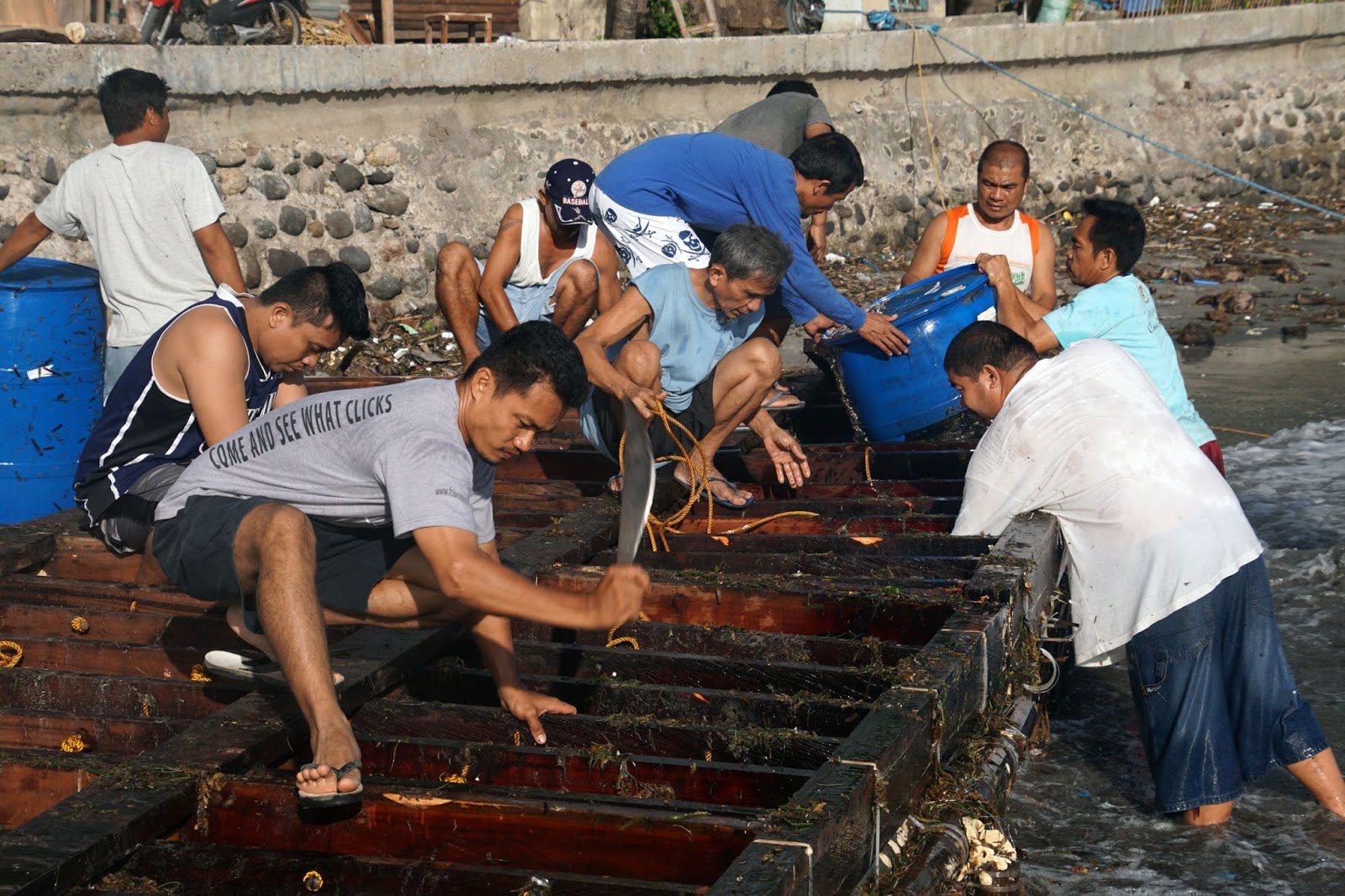
In less than a week, Foundation University workers went to the wreckage site of the collapsed floating pyramid.  Demonstrating the spirit of bayanihan, (a Filipino term referring to a community that comes together to accomplish a great task) 15 workers joined together to tow in the remaining platform and clear the debris washed ashore over the past week.  On Saturday the crew, led by Zorich Guia, the record architect, and Julie Mayoga, Estudio Damgo alumnus, borrowed an inflatable boat to determine the condition of the seaflex anchoring system and the remaining floating platform.  The crew checked all areas of the collapsed structure.  A volunteer diver who worked on the project, looked at the condition under the water and discovered that one of the ropes tied to the seaflex anchor had been severed from an unknown cause.  Above, it appeared the platform broke in two at a construction joint; one of the halves drifted ashore by the force of the waves, the other half stayed anchored to the seaflex.  After determining this, the crew set out on Sunday to tow in the platform and cleanup the debris that continued to wash ashore.  The fish wardens will dive later to take up the seaflex still anchored to the seabed floor.

At the end of the day, it is in the spirit of bayanihan and those returning faces lending a hand in the cleanup, that will be remembered by the community.  It is in the attitudes and dedication, like returning Estudio Damgo alumnus, Julie Mayoga, that reflects back on Foundation University's program saying,

"It's for everybody, I'm doing it on behalf of the Estudio Damgo 3 team that in despite of what had happened we're still committed to our beneficiaries, the barangay, and to the community for a long term partnership." - Julie Mayoga


The cleanup crew in the spirit of bayanihan. - Photos courtesy of Hersley Casero
Zorch Guia, Efren Disor, and two workers atop the floating platform, secure the ropes to tow ashore.
I (Anna Koosmann) assist the end of the human chain to fight the waves while towing in the platform.


Jumping to action, a man leaps from shore to assist the crew.


The spirit of bayanihan.
Platform arrives intact with workers guiding the efforts.
15 workers quickly dismantle the platform to haul off site.
The crew chips away at the platform.

Worker hands off a bamboo pole to Efren Disor.
Hauling off blue barrels that once were tied to the underside of the platform.
Workers swiftly take apart the platform.
A resident from the fishing community grabs an axe to pitch in.
Julie Mayoga, Estudio Damgo alumnus, and I (Anna Koosmann) team up to clear the wreckage from the beach.
All the washed-up mahogany ready to be hauled off site.
Zorich Guia holds up the severed rope that once secured the platform to the anchoring system.
Looking at three, intact ropes and rubber chords that held the platform to the anchoring system.
Zorich Guia, Efren Disor, and Nong Corro suits up to dive the wreckage site.

A mid-morning break, the workers cook up a pot of rice on the beach with canned sardines to keep their energy up for the rest of the cleanup.
Foundation University workers hauling away the blue barrels from the site.

Monday, November 2, 2015

Nature Forces Collapse on Floating Pyramid


After the collapse, the raft structure is all that remains of the floating Marine Sanctuary Center, undergoing high tidal waves this past weekend.
The community's concerns that the floating structure would not hold up through typhoon season, were validated this past weekend.  On Saturday evening, October 31, the Marine Sanctuary Center collapsed.  Floating for a short five months since June, the structure was impaired by high tidal waves on Friday and Saturday.  The fishing community observed on Friday, that the waves were higher and stronger, and the tidal forces were putting noticeable strain on the structure.  By Saturday evening, the pyramid fully collapsed (unoccupied) and the pieces were dislodged and washed ashore.  The next morning, eight fish wardens (bantay dagat) collected the washed-up mahogany wall panels and bamboo framing.  On Monday, the director of research, Geraldine, and I went to the site to see the damage.  Upon our approach, Nong Corro, the fish warden president, was towing in the pieces from the collapse.  What remains floating and tied to the anchoring system is the bamboo and barrel raft; however, that too is likely to dismantle as the impaired structure continues to endure tidal forces.

This unfortunate event is evident that the forces of nature (most notably water) are powerful.  And in witnessing such an event, it is our duty as architects to work within our limits for the health, safety, and welfare to serve the general public.  It is important that we learn from this ambitious project; we must design and engineer our structures for lasting positive impact to the community, instead of relishing in short-term achievements.  Estudio Damgo III set out to design, build, and float their structure; and they accomplished just that.  It is in the wake of the aftermath, that we see the value in designing for long-term goals and understand the full objectives for whom the design serves.

Discussions in the university architecture department are underway to remedy this situation swiftly.  We're taking input from the community and salvaging the intact pieces in order to rebuild the structure on firm ground.  A reassuring response by Foundation University President, Victor Sinco, highlights our commitment and partnership with the barangay council and community members, stating:

"It’s unfortunate that the structure collapsed over the weekend. But let’s not despair, part of the project's priorities is to illustrate the sustainability aspects of each project. So let’s get the community to invest some labor while we can provide the materials." - Victor Sinco
 
Nong Corro, fish warden president, collecting the washed ashore debris from the collapsed structure.
Nong Corro towing in the mahogany wall panel.  Flattened structure remains anchored and floating in the distance.
Mahogany wall panels piled along the road.  Salvaged materials can be used to rebuild the structure on land.
Geraldine peeks inside one of the blue barrels, which had washed ashore.  She is a research biologist and sees that limpets have attached to the barrels where the caps once were, indicating that the barrels had lost there seal for a duration of time, and could be one of the causes of induced strain on the structure.
The photo shows a missing cap to the blue barrel.  Limpets have attached inside the opening, indicating the seals have been missing for a while and barrels would be completely filled with water, putting strain on the structure.

Thursday, October 29, 2015

Panaghiusa Multipurpose Visit

Core Shelter residents honor the death of a community member by playing games, eating food, and sharing stories at the multipurpose hall.
Each time I visit Core Shelter community and the multipurpose hall, I learn something new.  Today, I happened to witness an unexpected event.  Foundation U. workers and I were visiting Core Shelter to assess the building condition for maintenance and improvements.  As we approached the community,  residents were gathered at the steps of the multipurpose, playing bingo and eating food.  It appeared as if we stumbled upon a fiesta celebration of sorts.  I soon came to realize after speaking with ma'am Johna David, that two elderly women had passed away within a weeks time of each other, and the residents were using the multipurpose to hold the wake and funeral services.

It is Filipino tradition to honor the death of a loved one by hosting a wake at the family's home.  The casket is typically placed inside the home where family and friends can commune and visit day and night.  Funeral wakes and visitations can last up to two weeks.  They believe in celebrating their life, by playing games and sharing food and conversation while also comforting family members, so that they are not alone.  It is a time of celebration and in this case, Core Shelter homes are very small and it would be cumbersome to have a casket inside the home for so many days.  The multipurpose hall is suited for the residents, friends, and families who will visit over an extended period of time.  The building design is open to receive many visitors, at all hours, without compromising the family's domestic life.  It's great to know that the building has served so many uses for very special occasions.

Funeral casket placed inside the multipurpose.
Foundation worker climbs the ladder to patch a hole in the gutter while the funeral wake activities pursue.
Anna Koosmann (myself) pictured with Johna David.


Followers